A Rocky Planet in a Habitable Zone Still Has an Atmosphere
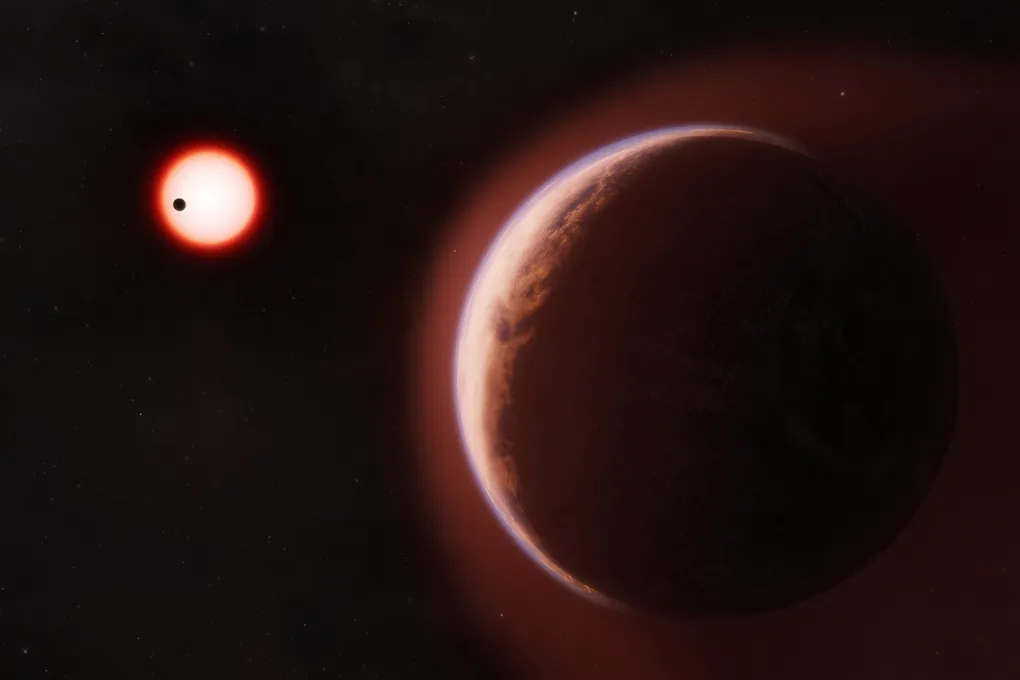
For years, astronomers could find rocky planets in the right orbits and still not answer the next question: do any of them keep an atmosphere? On 16 July 2026, Science published the first clear answer for a world in another star’s habitable zone. Near-infrared spectra show helium escaping from LHS 1140 b, a rocky planet about 48 light-years away. The gas is not a breathable sky. It is a leak, and a leak only makes sense if there is still an atmosphere to leak from.
What the team actually measured
Collin Cherubim and colleagues used the Warm Infrared Echelle Spectrograph (WINERED) on the Magellan Clay telescope at Las Campanas Observatory in Chile. During a transit, starlight filters through the planet’s upper atmosphere; at a specific infrared wavelength, helium absorbs some of that light. The team recorded that absorption for LHS 1140 b in 2024. A second, closer planet in the same system, LHS 1140 c, showed none.
The 2025 visit did not recover the helium line. That does not mean the atmosphere vanished between seasons. Helium is easiest to see from Earth when it is excited; stellar activity and viewing conditions change how visible that excited state is. The paper treats the signal as time-variable atmospheric escape, not as a one-night fluke followed by disappearance.
Lead author Cherubim had predicted the result before the telescope time. His models of atmospheric fractionation argued that over billions of years, stellar heating strips the lightest gas, hydrogen, first, leaving an upper atmosphere that can become helium-rich while heavier volatiles stay lower down. David Charbonneau, one of his advisors at Harvard, called the subsequent detection “statistically rock solid.” The observation also mattered for method: a ground-based spectrograph, not a space telescope, produced the first such signal for a rocky habitable-zone world.
Why this planet was a fair target
LHS 1140 b was found in 2016 by Jason Dittmann and the MEarth survey as a transit across a faint red dwarf. It is a super-Earth, not an Earth twin: roughly 5 to 5.6 times Earth’s mass and about 1.7 times Earth’s radius. It receives about half the sunlight Earth does, yet still sits in the region where liquid water is not ruled out by stellar distance alone.
Red dwarfs often shred atmospheres with flares. LHS 1140 appears quieter. It rotates slowly, about once every 130 days, and has not been seen to flare in the way that stripped candidates in systems such as TRAPPIST-1. Age and irradiation still matter. X-ray measurements of the star set how fast helium should boil off. At that loss rate, the helium seen in 2024 should already be gone unless the planet keeps replenishing it from a deeper reservoir. That is the core argument for a lasting atmosphere rather than a brief burp of gas.
Modeling in the study and commentary around it favors a water-rich interior: a mostly Earth-like rocky bulk plus on the order of 10% water by mass, rather than a dry rock under a thick dry envelope. That is a water-world scenario, not a confirmed ocean shoreline. The same models leave room for water vapor, carbon dioxide, carbon monoxide, and small amounts of oxygen lower in the atmosphere; none of those species were identified in the WINERED helium line.
What the result does not show
It does not show a breathable atmosphere, surface liquid water, or life. The measurement is helium escaping from the upper atmosphere. Composition of the bulk air, surface pressure, and climate remain open.
It also does not make LHS 1140 b “Earth-like” in the everyday sense. Its mass and radius put it among super-Earths and near the so-called radius gap, the underpopulated band of planets between about 1.5 and 2 Earth radii. One live reading is that some worlds in that range are mid-transition: former mini-Neptunes losing hydrogen envelopes and becoming denser rockier planets. Helium-dominated upper atmospheres would fit that story; Cherubim and others have framed such objects as a possible “helium world” class. The planet may still be finishing that transition rather than sitting as a finished terrestrial twin.
Earlier JWST work on rocky worlds, including this system, had been inconclusive on atmospheres. The helium detection raises the priority of follow-up; it does not finish the job.
What comes next
LHS 1140 b is already on the target list for the Rocky Worlds Director’s Discretionary Time program on JWST and Hubble. That campaign is built to look for atmospheres on rocky planets around dwarf stars. Over the next four to five years, searches for water and carbon dioxide should test whether the helium sits above a stable, multilayer atmosphere or above a thinner, intermittent one. Cherubim has also secured Magellan time on a similar planet around a similar star, treating LHS 1140 b as a prototype rather than a one-off.
Why it counts as human progress
The sequence of questions has tightened. Twenty years ago the field asked whether terrestrial-type planets existed at all. Then whether any sat in habitable zones. The next barrier was atmospheric retention around small worlds, especially around red dwarfs. One planet now clears that barrier with a ground-based spectrum and a prediction made before the data arrived.
That matters because atmospheres set climate, radiation shielding, and whether water can stay liquid. A confirmed atmospheric leak on a rocky habitable-zone planet is not a biosignature. It is the missing middle step: proof that at least one such world still holds onto air after more than three billion years, and that we can find that air from Chile before we ask JWST for the rest of the chemistry.