Intelligence Without a Brain: Slime Molds, Ant Colonies, and Distributed Cognition
Cognition does not require a brain. It does not even require neurons. Two findings reported in 2026, one from a single-celled organism and one from colonies of insects, show problem-solving that emerges from physics and local rules rather than from any central controller. The science that studies this has a name, distributed cognition, and it is forcing a wider definition of what counts as thinking.
A slime mold that decides with its own body
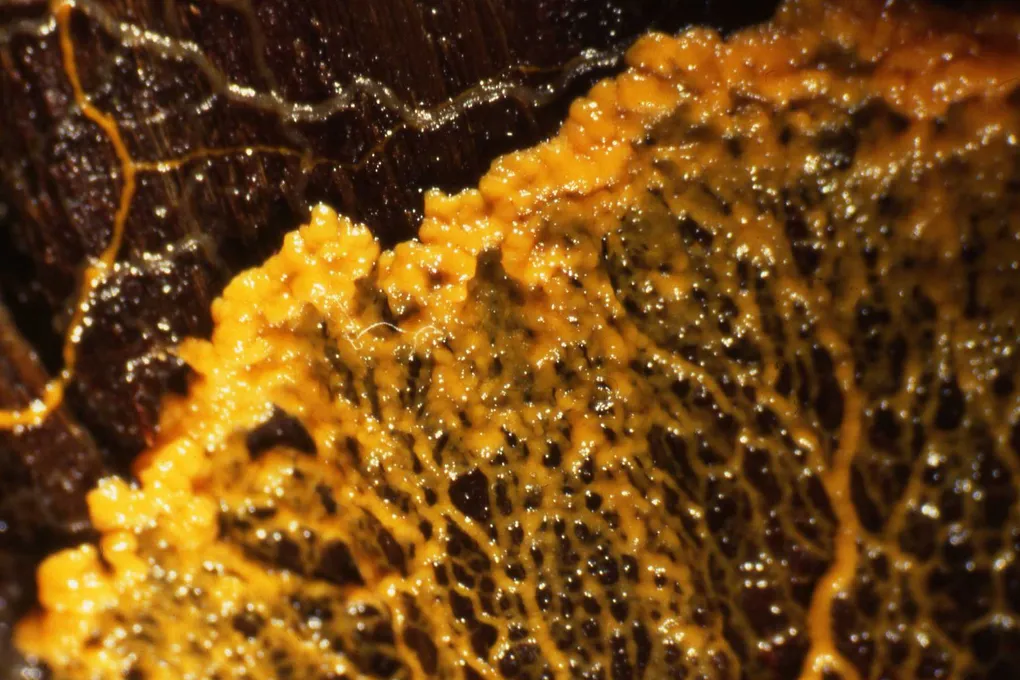
Physarum polycephalum is a slime mold: one giant cell, no neurons, no organizing center. It still makes choices. It moves and feeds by pumping its internal fluid back and forth through rhythmic peristaltic contractions, the same kind of squeezing motion that pushes food through your gut, and that flow redistributes its mass toward or away from things in its path.
Lisa Schick, Karen Alim, and colleagues turned that behavior into a controlled experiment, published in PRX Life in June 2026. Slime molds avoid light, so the team used blue light to wall the organism into polygonal cages and watched how it found a way out. The escape route was consistent: the cell broke out along the longest axis of the polygon, whatever the cage’s shape. Before committing, it did not push toward the exit and nowhere else. It extended protrusions almost everywhere around the boundary at once, testing the whole perimeter.
The mechanism sits in the contractions. The protrusions lined up with the direction of the peristaltic waves moving mass through the cell, and the organism kept switching between different dominant contraction patterns as it explored. Only over time did it settle on the single pattern that moves cytoplasm most efficiently, and that settling coincided with the escape. The authors report that harsh confinement was the trigger; optimal behavior appeared only after a long reorganization of the internal flow. A creature with no nervous system reached a good answer by reshaping its own plumbing until the physics pointed one way.
An ant colony with no one in charge
Scale up from one cell to millions of bodies and the same lesson holds. Ants are one of the most successful groups of animals on Earth, with an estimated 20 quadrillion individuals living on every continent except Antarctica. As the University of Sydney entomologist Tanya Latty puts it in The Conversation, the obvious question is who runs a colony, and “the answer is simple: no one.”
The queen is not a manager. Her job is to lay eggs and keep the workforce stocked; in some species, workers kill a queen whose productivity drops. Direction comes from the bottom up, through local interactions, in what biologists call a self-organized system. Latty draws the parallel to the brain itself: a single neuron cannot think, yet 86 billion of them, each following simple rules, produce the full range of human thought.
Foraging shows the trick in action. A worker that finds food lays a trail of chemical pheromones on the way home, other ants follow and reinforce it, and because the markers evaporate, shorter routes get walked more often and stay strong while longer ones fade. No ant compares the routes. The colony “discovers” the shortcut as a side effect of evaporation and traffic. Nest building runs on the same logic through a process called stigmergy: in the black garden ant Lasius niger, a worker shapes excavated soil into pellets carrying a chemical cue that makes other ants drop their pellets nearby, and pillars, walls, and roofs accrete with no ant holding the plan. The same mechanism raises termite mounds and honeycomb.
Group size is where ants and people part ways. Latty cites work in which human teams asked to move a T-shaped object through a tight gap got no better as they grew, and got worse when forbidden to talk, an echo of the long-known Ringelmann effect, where individual effort falls as a group enlarges. Ant groups showed the opposite: bigger teams performed better.
The shared principle: many simple parts, one competent system
Put the two cases side by side and the common ingredients are clear. There are many components following local rules, a physical or chemical medium that carries information between them (contraction waves in the cell, pheromones in the colony), and feedback that amplifies what works and lets the rest decay. Out of that comes behavior that looks deliberate without any deliberator. This is the core claim of distributed cognition: thinking can be a property of a system, spread across bodies and environment, not a thing that happens only inside a skull.
That reframing pays off in engineering. Pheromone-style evaporation and reinforcement is the basis of ant colony optimization, a family of algorithms used to route traffic and schedule networks. Slime-mold flow dynamics have been studied as a model for designing efficient, fault-tolerant transport networks. Swarm robotics borrows the same rule: give many cheap units simple local behaviors and let coordination emerge, rather than programming a master plan.
What these results do not show
The word “decision” here is mechanical, not conscious. The slime mold is not weighing options the way a person does; it’s a flow system relaxing toward an efficient state, and the PRX Life study deliberately measures contraction modes rather than attributing intent. The ant findings describe self-organization, not a colony-level mind with goals of its own. Both papers also study constrained setups, a single organism in a light cage and specific colony tasks, so the rules that produce smart behavior in one context need not generalize to every problem these organisms face.
Why it counts as human progress
These studies widen the catalog of how intelligence can be built. For most of history we treated the brain as the only seat of cognition, which left the problem-solving done by cells, colonies, and immune systems looking like a different category. Showing that a brainless cell and a leaderless colony reach good answers through the same recipe, local rules plus a shared medium plus feedback, gives us a portable design we can study, copy, and improve. It also lowers the bar for building useful artificial systems: coordination need not be commanded from the top. Some of the most capable behavior in nature has never had anyone in charge.
Drafts may be assisted by AI. Every published article is reviewed and edited by a named member of our staff before publication.