The galaxy left a receipt in Antarctic ice—and we finally read it
Every snowflake that has ever fallen on Antarctica brought a little of the sky down with it—including, it turns out, the ash of exploded stars. A team of physicists has now sifted that ash out of ancient ice and used it to chart something almost unimaginably large: the Solar System’s slow drift through a cloud of interstellar gas, recorded one frozen layer at a time.
The study, led by Dominik Koll of the Helmholtz-Zentrum Dresden-Rossendorf, appeared in Physical Review Letters in May 2026. Its central character is a single, stubborn atom: iron-60.
Why one isotope matters so much
Most iron is ordinary and ancient. Iron-60 is neither. It is radioactive, with a half-life of about 2.6 million years, and it is made almost exclusively in supernovae—the explosive deaths of massive stars. On a planet as old as Earth, any iron-60 that formed here has long since decayed away. So if you find it in recent ice, it did not come from Earth. It fell from space.
That makes iron-60 a kind of cosmic postmark. Detect it, date it, and you can ask when nearby stars last seeded our corner of the galaxy with debris.
What the team actually did
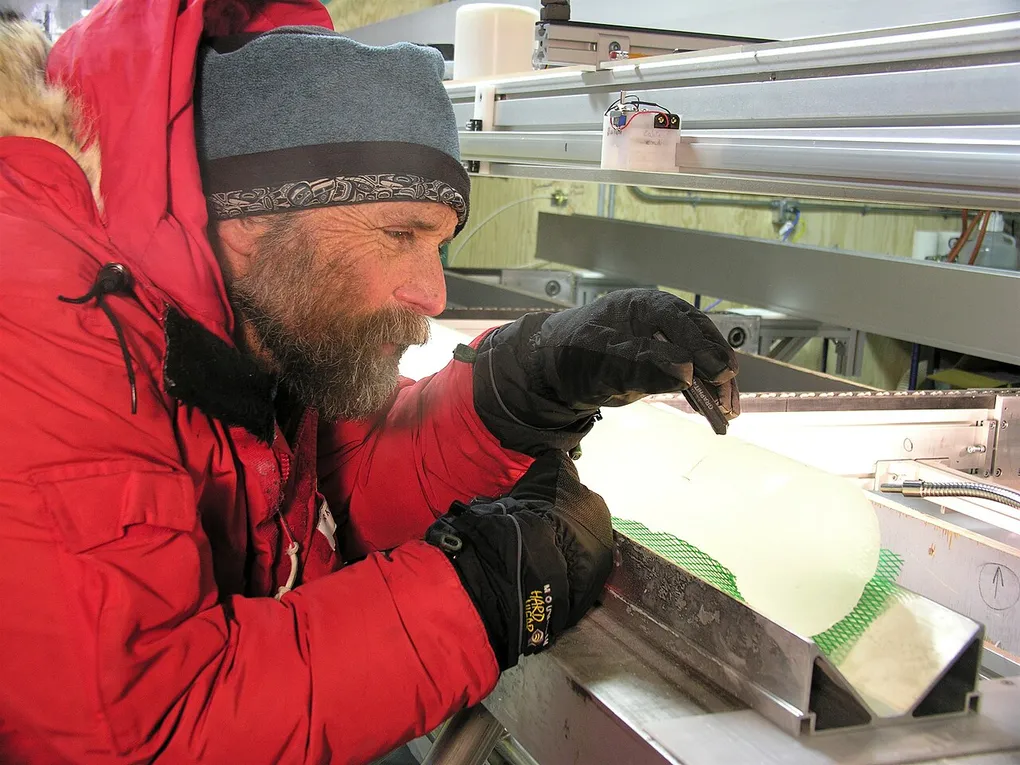
The researchers worked with roughly 300 kilograms of ice from the European EPICA project, covering snow that fell between 40,000 and 80,000 years ago. Getting a few atoms of iron-60 out of that much frozen water is closer to forensic chemistry than astronomy:
- Melt the ice without contaminating it.
- Extract the trace iron chemically.
- Count the iron-60 atoms with accelerator mass spectrometry—sensitive enough to find a handful among quadrillions of ordinary atoms.
They also measured manganese-53, which arrives with everyday interplanetary dust, as a control, and stitched their results together with modern Antarctic snow and deep-sea sediment records from earlier studies.
The pattern in the ice
Here is the surprising part. In the 40,000–80,000-year window, Earth received less iron-60 than it does today.
That small dip carries a big implication. Across the full 80,000-year record, the influx of iron-60 is not flat, and it is not a smooth decline. It rises and falls—exactly what you would expect if the Solar System were gliding into a region of space that is itself unevenly seeded with stardust.
That region is the Local Interstellar Cloud (LIC): a wispy patch of gas and dust, one of about fifteen clouds in the Sun’s neighborhood, that our Solar System is passing through right now. Independent astronomy suggests we entered it sometime between 40,000 and 124,000 years ago—and the ice record’s turning point falls neatly inside that range. The authors describe the cloud as a “cosmic archive” of supernova iron-60, with Earth’s ice as the ledger we can finally open.
What this does not prove
This is genuinely exciting, which is exactly why it is worth stating the limits plainly:
- It is one isotope, one core, one interval. A single ice section cross-checked against limited marine and snow data is a strong clue, not a finished map of the cloud.
- The cloud’s origin is unsettled. If the LIC came from one supernova, some models predict more iron-60 than was measured. Density variations within the cloud—or multiple explosions over millions of years—remain live possibilities.
- The calendar stays fuzzy. The ice narrows when we entered the LIC; it does not pin an exact date.
- There is no threat here. This is about faint interstellar dust, not a hazard to life. The payoff is understanding, not alarm.
The natural next step is older ice. Drill deeper, and the same technique could test whether these neighboring clouds share a common explosive parent.
Why it counts as human progress
It turns a planet into an instrument. We measured galactic structure from grams of meltwater at the bottom of the world. That is the quiet genius of modern science—reading the cosmos in materials we already had.
It widens the frame. Earth is not a sealed terrarium. It rides through a galaxy that still showers it with the remains of dead stars. Knowing the larger environment our biosphere travels through is part of taking the long view of human flourishing—not to unsettle us, but to locate us.
It rewards patience. No headline-grabbing application follows tomorrow. But better models of the Sun’s galactic surroundings are the kind of slow, cumulative knowledge that future science—and future generations—will build on.
Primary sources
- Paper: Koll et al., Phys. Rev. Lett. 136, 192701 (2026)
- Synopsis: Physics / APS — “Finding Stardust in the Ice”
- Institution release: EurekAlert / HZDR
The next time you picture Antarctica, picture an archive. Beneath that white silence, layer by layer, the galaxy has been keeping records—and we are just learning to read its handwriting.
Drafts may be assisted by AI. Every published article is reviewed and edited by a named member of our staff before publication.