Sperm whale “vowels” and human-like phonology—what the 2026 study adds
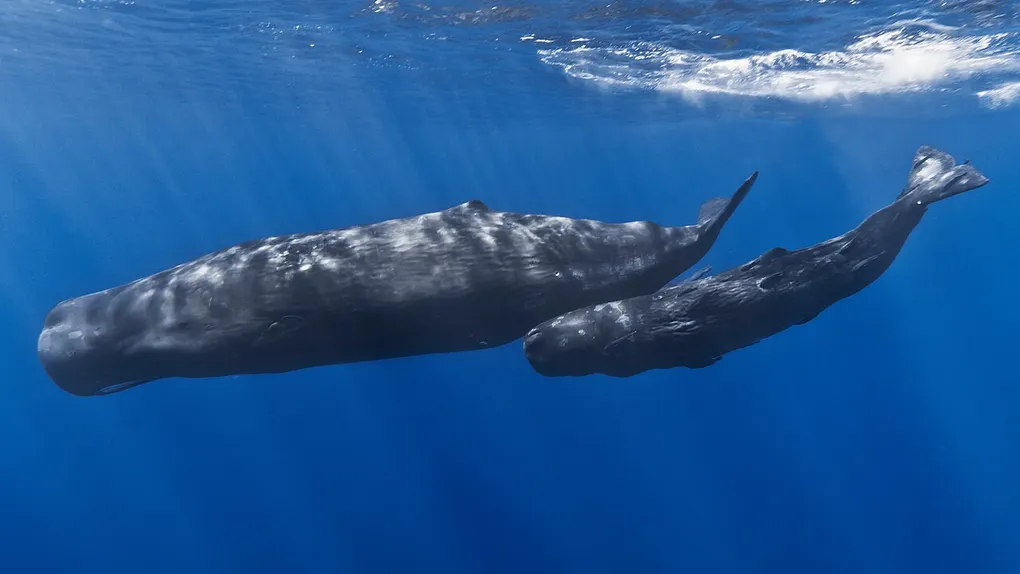
Ninety million years of evolution separate us from sperm whales. Yet their clicks keep sounding less alien—and more organized—than we assumed.
In April 2026, researchers affiliated with Project CETI reported in the Proceedings of the Royal Society B that sperm whale codas (rhythmic click sequences) show patterns strikingly similar to human phonology: vowel-like categories, length contrasts, and even something like coarticulation, where neighboring sounds influence each other. The Guardian called it a “humbling moment.” The honest headline is narrower—and still remarkable.
How this builds on the 2024 “alphabet” work
In 2024, CETI and MIT researchers showed that whale codas vary along combinatorial dimensions—rhythm, tempo, rubato, ornamentation—forming a rich “phonetic alphabet” of click types (Nature Communications). We explained that finding here with an important caveat: structure is not meaning. The whales had organized signals; we still could not read them.
The new paper, led by linguist Gašper Beguš and colleagues, zooms in on a layer inside those codas. When gaps between clicks are compressed, individual clicks show formant structure—frequency patterns that, in human speech, distinguish vowels. CETI had previously identified two quality types, nicknamed a-codas and i-codas. This study asks: do whales use those types systematically, the way languages use vowels?
What the 2026 study found
Analyzing thousands of codas from 15 sperm whales recorded off Dominica (2014–2018), the team reports five properties that mirror human phonetics:
- Vowel quality interacts with coda type. Traditional count- and timing-based codas combine with a- versus i-quality—not as random mixing.
- Duration contrasts. a-codas tend to be shorter; i-codas show a bimodal split between short and long forms—analogous to length distinctions in languages like Arabic.
- Individual “accents.” Baseline coda length differs whale to whale, as human speakers vary in timing.
- Structured sequences. In some rhythmic patterns (e.g. “click … click … click-click-click”), a- and i-types appear in deliberate ratios; other patterns favor mostly a-codas.
- Coarticulation-like effects. Edge clicks that “mismatch” their own coda sometimes match an adjacent coda—similar to how human speech sounds bleed into neighbors.
The authors conclude that sperm whale vocalizations may represent “one of the closest parallels to human phonology of any analysed animal communication system,” possibly through independent evolution—not shared ancestry with humans.
What we still do not know
Guardian-style headlines about “parallels to human language” are easy to overread.
- No dictionary. Knowing that clicks pattern like vowels does not tell us what whales say—no translations, no confirmed words.
- “Vowel” is an analogy. a-codas and i-codas are named for acoustic similarity to human /a/ and /i/, not proof whales share our articulatory anatomy.
- Language requires more than phonology. Grammar, semantics, and cultural transmission remain unmapped. Parallel structure in form is not parallel structure in meaning.
- Sample limits. Caribbean families of mostly females and calves; other populations may differ.
CETI’s long-term project—ethical listening, larger datasets, possible playback experiments—continues. Each paper adds resolution; none yet delivers a phrasebook.
Why this matters for human progress
Scientifically, convergent communication systems are a gift: they let linguists test which patterns might be cognitive universals versus accidents of human history.
Ethically, every layer of structure strengthens the case that sperm whales are not mute background fauna but social minds whose acoustic world we are only beginning to map. That matters for shipping noise, sonar, and conservation—human progress includes sharing the ocean without silencing another species’ conversation.
Philosophically, the story humbles without flattening: we are not the only species assembling speech-like building blocks. Progress is not only our inventions—it is sometimes recognizing intelligence we overlooked.
What to read next
- Primary paper: The phonology of sperm whale coda vowels (open access)
- Accessible coverage: The Guardian, Scientific American
- Our 2024 explainer: Whales may use a combinatorial “phonetic” code
The whales are not speaking English in the deep. But they may be running a phonological engine of their own—and that is more than enough to warrant careful listening for decades to come.
Drafts may be assisted by AI. Every published article is reviewed and edited by a named member of our staff before publication.