Humans Are Still Evolving, and in Some Bizarre Ways
A common story about our species says evolution stopped once we built houses, grew our own food, and started treating disease. The data say otherwise. Across the past decade, geneticists have caught natural selection acting on living human populations, sometimes within a single lifetime. The traits under selection are not the ones science fiction promised. They are kidneys, spleens, skin, and eyes, shaped by water, oxygen, sunlight, and screens.
Turkana kidneys tuned for 1.5 liters of water a day
The Turkana of northwest Kenya herd camels, cattle, sheep, goats, and donkeys across a semi-arid desert, and they live on what those animals provide. In some seasons, 70 to 80% of their diet is animal-derived, and daily protein intake runs more than 300% above the FAO/WHO requirement on just 1,300 to 1,600 kcal a day. They drink about 1.5 liters of water daily, roughly a quarter of what an outsider needs to function in that heat, and they stay mostly free of chronic disease.
Amanda Lea, Julien Ayroles, and their colleagues sequenced 367 whole genomes and screened nearly 7 million genetic variants. They reported the results in Science in September 2025. Eight regions of the genome showed signs of recent positive selection. The strongest sat next to STC1, a kidney-expressed gene, with a selection coefficient near 0.041.
STC1 does two jobs that map onto desert pastoralism. It responds to antidiuretic hormone, so the kidneys concentrate urine and hold onto water. It also appears to protect the kidneys from the urea and uric acid that a red-meat diet generates; gout, the usual penalty for high dietary purine, is rare among the Turkana. The same gene is under selection in a second East African group, the Daasanach, which strengthens the case that this is adaptation rather than chance.
Then the lifestyle changes. More than 90% of pastoralist Turkana regularly consume blood, milk, and red meat. Among Turkana who move to cities, those figures fall to 0% for blood, 47% for milk, and 31% for red meat, with the rest of the diet bought at market. Comparing kidney-function biomarkers across 447 people, the team found the urban group drifting toward hypertension, kidney dysfunction, and diabetes risk. A genome built to survive on little water turns into a liability with a tap and a supermarket. Biologists call this evolutionary mismatch.
Bajau spleens built for breath-holding
The Bajau, a sea-nomad people of Southeast Asia, dive on a single breath to gather food from the seafloor. Melissa Ilardo and colleagues measured their spleens with portable ultrasound and compared them to the neighboring Saluan, who farm. The Bajau spleens averaged about 50% larger. The result appeared in Cell in April 2018.
Spleen size matters underwater because the spleen stores oxygenated red blood cells and squeezes them into circulation during a dive. A larger reservoir buys more time on one breath; the senior author Rasmus Nielsen estimated roughly 10% more red blood cells available mid-dive. The size difference held between Bajau who dive and Bajau who do not, which rules out training as the cause and points to genetics. The selection scan flagged 25 sites; one variant in the PDE10A gene tracked with spleen size, and a separate signal in BDKRB2 affects the mammalian diving reflex. The Bajau split from the Saluan around 15,000 years ago, time enough for selection to do this work.
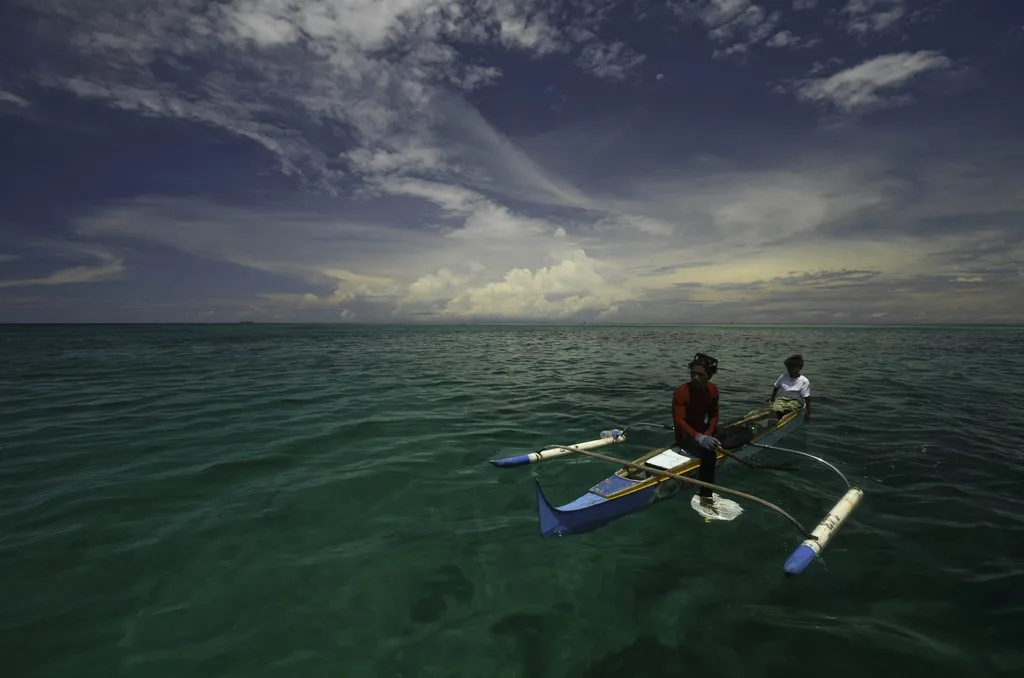
Photo: Wikimedia Commons / fairuz othman (CC BY 2.0)
Skin, eyes, and the last 40,000 years
Light has been editing the human body for far longer, and the edits are still legible. As populations left bright African climates for cloudier temperate zones, lighter skin evolved repeatedly, through different genes in different populations, probably within the past 40,000 years. The trade-off was concrete: less pigment lets scarce ultraviolet light through to make vitamin D, at the cost of weaker protection against sun damage. Australia, where more than half the population is of light-skinned Anglo-Celtic descent living under high UV, now has among the highest skin-cancer rates in the world.
Eyes carry the same fingerprint. People from high latitudes tend to have less pigment in their irises and larger eye sockets, plausibly to gather more of the dim northern light. The hypotheses reach back further still: curly hair may insulate the scalp against tropical sun, and walking upright reduces the body area the midday Sun can strike.
Myopia: selection you can watch inside one lifetime
Most examples of human selection took thousands of years. Short-sightedness is moving faster. Many genes linked to myopia have grown more common in roughly 25 years, a change in the human gene pool visible within living memory. The genes do not act alone: a person with a genetic predisposition who spends less time in natural daylight and more under artificial light is more likely to become myopic. The lesson is that a new environment, in this case indoor lighting and screens, can reweight which variants spread, and it can do so quickly.
A stonefly shows how fast humans bend other species
We are not only subjects of rapid evolution; we are one of its strongest drivers. In New Zealand, Shu Ni and colleagues studied a stonefly that mimics the warning coloration of a toxic relative, Austroperla. Reported in Science in 2025, their analysis of 1,200 specimens found the mimic repeatedly shifted color as forests were cleared and the bird predators that punish bad mimics thinned out. The same color-controlling gene, ebony, was selected again and again across separate lineages, and predation experiments showed which color paid off depended on whether the habitat was forested or logged. Cut down a forest, and within generations the insects in the stream change color. The mechanism in people differs, but the speed is the point: human activity is now a routine evolutionary pressure.
The bigger shift: from genes to culture
There is a reason genetic selection on humans can look weak in the modern world. We increasingly solve survival problems with culture instead of DNA. Eyeglasses correct the myopia that genes spread. Cesarean sections and fertility treatments let people reproduce who once might not have. In a 2025 BioScience paper, Timothy Waring and Zachary Wood argue that this is a structural change, not a footnote. They propose an Evolutionary Transition in Inheritance and Individuality: the primary engine of human adaptation is moving from genes to learned, shared culture, and the key unit from the individual to the group.
Their claim is that culture adapts faster than DNA, so it often reaches a solution before natural selection can act on genes, a process they call cultural pre-emption. “Cultural evolution eats genetic evolution for breakfast, it’s not even close,” Wood told Newsweek. Waring framed the same point as a gear change: “Human evolution seems to be changing gears.” The paper is a hypothesis with testable predictions, not a settled result, and biologists have long been skeptical that a true evolutionary transition is underway in our species. It is worth watching because it reframes the others: genetic adaptation has not stopped, but for many traits, culture now gets there first.
Why this counts as human progress
Each of these findings turns a population’s way of life into a working model of human physiology. STC1 points to new biology of dehydration and kidney protection, with possible relevance to hypertension and gout in the rest of us. PDE10A and BDKRB2 open a genetic window on hypoxia tolerance that medicine has otherwise only studied at high altitude. The myopia trend tells us an environmental lever, time in daylight, is partly within our control.
The throughline is evolutionary mismatch. The Turkana case is the clearest: traits that kept people healthy on 1.5 liters of water a day can raise disease risk once the environment flips to abundance. We are still adapting to deserts and oceans our recent ancestors lived in, while building cities those bodies never met. Reading our own genome as a record of that lag is how we start to design environments that fit the species we actually are.
Drafts may be assisted by AI. Every published article is reviewed and edited by a named member of our staff before publication.