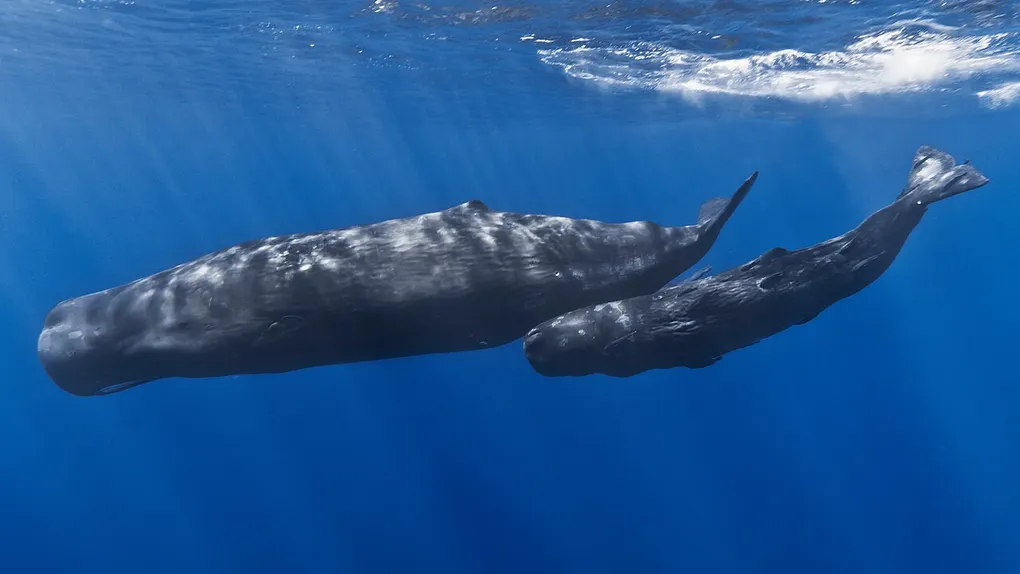
Whales may use a combinatorial “phonetic” code—what the 2024 study actually found
Sperm whales carry the largest brains on Earth. For decades, scientists have known they exchange information through codas—short bursts of clicks. What we did not know is how much structure hides inside those clicks until researchers applied modern machine learning to thousands of recordings from Caribbean whale families.
What the study found
In May 2024, a team from MIT’s Computer Science and Artificial Intelligence Laboratory and Project CETI reported in Nature Communications that sperm whale vocalizations are far more structured than a simple repertoire of fixed call types.
Analyzing more than 8,700 codas from the Dominica Sperm Whale Project, the researchers identified 156 distinguishable coda types—not the roughly 21 categories often cited before. More importantly, variation along a small set of dimensions—rhythm, tempo, rubato (smooth speeding and slowing), and ornamentation (extra clicks)—combines in ways the authors compare to a “sperm whale phonetic alphabet.”
That analogy is deliberate. Like human phonemes, basic elements appear to combine into a larger inventory of vocal units. Whales also adjust features in context—for example, mirroring tempo changes in a conversation—suggesting communication is responsive, not rote.
What we do not know
Headlines sometimes imply we have “decoded whale language.” We have not.
- Meanings are unknown. The paper maps structure, not semantics. We cannot yet translate codas into concepts.
- “Alphabet” is a metaphor. It highlights combinatorial patterning, not a written script or confirmed grammar.
- Duality of patterning—where meaningless units build meaningful words—is discussed as a possibility, not a proven feature of whale communication.
Project CETI’s long-term goal is careful, ethical listening and, eventually, interactive experiments. That work will take years.
Why this is human progress
Progress is not only vaccines and microchips. It is also expanding the circle of minds we take seriously.
If combinatorial structure is confirmed and extended, it may reshape conservation ethics, acoustic pollution policy, and our sense of intelligence beyond primates. Sharing a planet with another communicative species is a reminder that flourishing is not a solo human project.
What to watch next
Peer replication, larger datasets from other whale populations, and CETI’s playback studies will test whether these patterns hold and whether whales respond to structured signals. Until then, the honest headline is narrower and still wondrous: sperm whale clicks are organized more like language than we thought—not yet read, but no longer noise.
Drafts may be assisted by AI. Every published article is reviewed and edited by a named member of our staff before publication.